
Siera Alliance

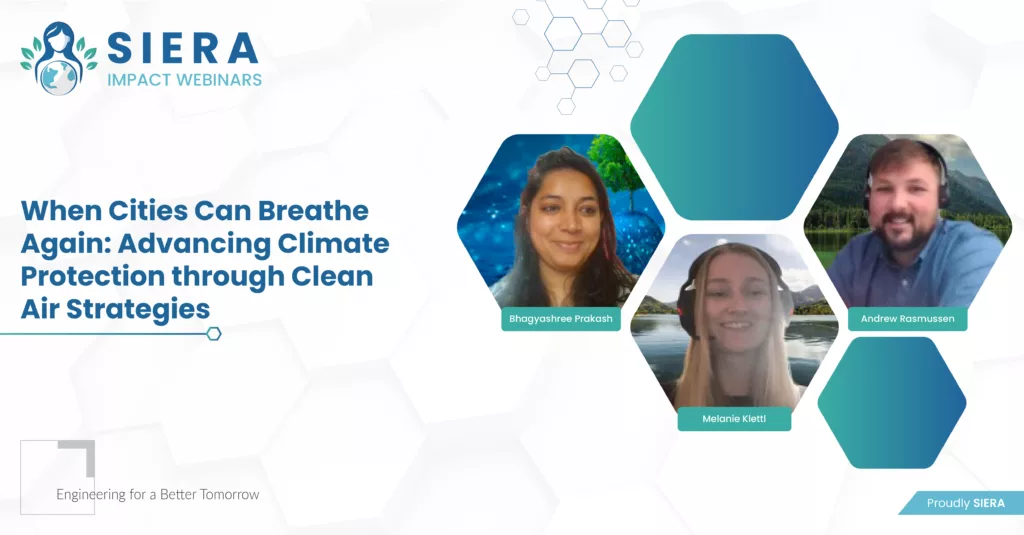
When Cities Can Breathe Again: Advancing Climate Protection through Clean Air Strategies

After Event Post

Introduction

Clean air is no longer just an environmental goal — it is a public health, economic, and climate resilience imperative. In our recent SIERA Academy Impact Webinar – When Cities Can Breathe Again, experts highlighted how European cities are transforming air quality challenges into opportunities for healthier, more sustainable urban futures.

The Four Challenges Cities Face

Despite progress in emission reductions, cities across Europe still face persistent pollution hotspots. Experts identified four interconnected barriers:

  1. Traffic-related emissions – Road transport remains the main source of nitrogen dioxide.
  2. Non-exhaust pollutants – Brake wear, tire abrasion, and road dust continue to dominate particulate matter.
  3. Heating and secondary pollutants – Fossil-fuel-based heating and hotter summers intensify winter smog and ozone levels.
  4. Planning gaps – Fragmented urban planning fails to integrate mobility, housing, energy, and green spaces.

Turning Compliance into Opportunity

Regulations like the EU Ambient Air Quality Directive and the European Green Deal set strict air quality standards. But compliance is more than a legal necessity — it’s an innovation driver. By aligning with these frameworks, cities unlock new opportunities in:

  • 🚴 Smarter mobility: low-emission zones, public transport, and cycling networks.
  • 🌳 Reducing non-exhaust emissions: smart traffic systems, street cleaning, and regenerative braking.
  • 🔥 Decarbonized heating: renewable district heating, electrification with heat pumps, and energy-efficient retrofits.
  • 🏙 Resilient city planning: green corridors, mixed-use development, and ventilation pathways.

European Case Studies

  • Paris: Expanded cycling lanes and low-emission zones reduced nitrogen dioxide and particulate matter.
  • Barcelona: “Superblocks” redesign limited through-traffic, improved air quality, and created healthier public spaces.
  • Munich & Chemnitz: Introduced mobility hubs, car-sharing, and electrified municipal fleets to cut greenhouse gases.

Why It Matters for Business

For organizations, clean air strategies are not just about compliance. They directly support ESRS reporting, improve long-term value creation, and open new markets in sustainable mobility, heating, and infrastructure.

Key Takeaway

Clean air strategies prove that climate protection and healthier cities go hand in hand. By adopting holistic approaches — smarter mobility, decarbonized heating, and integrated urban planning — cities can meet EU standards while unlocking economic and social benefits.

Facebook
Twitter
LinkedIn

Other Blogs

JOIN OUR FREE WEBINARS FOR VALUABLE INSIGHTS FROM OUR ENVIRONMENTAL ENGINEERS

A Message from the Founder: Florian von Tucher

In the mid-2000s my involvement in development aid took me to some of the most remote and impoverished regions of the world. 

Northern Tibet, Mongolia, and Western China – where I was involved with the implementation of decentralised wastewater treatment systems, I realised I needed a deeper purpose. Though I later found success in real estate development, the desire to make a lasting impact never left me.  

A pivotal moment occurred when I was invited to Ghana by my friend and mentor, Cardinal Peter Turkson, who was the head of the Dicastery for the Promotion of Integral Human Development of the Catholic Church at the time. He has since been appointed the Pontifical Chancellor of the Academy of Sciences and the Pontifical Chancellor of Social Sciences.  

Cardinal Turkson had a profound influence on me. His invitation gave me the opportunity to witness firsthand the development needs of the country. We reflected on my experiences in China, and together, we envisioned a model of development that would take root in one community and gradually expand. We believed that small, strategic steps could lead to lasting transformation – just like the biblical parable of the mustard seed, which grows into something far greater than its humble beginnings. 

Cardinal Turkson’s steadfast belief in this vision and encouragement became the base upon which the Mustard Seed Foundation was built. His unwavering support, wisdom, and guidance helped shape not just the mission of the Foundation, but my personal journey as well. 

With the encouragement of the Cardinal and the Integral Human Development (IHD) office, we initially operated with the IHD before establishing the Mustard Seed Foundation as a stand-alone organisation in Germany. We have been fortunate to receive support from numerous European donors, a humble reminder that our mission is not just about individual efforts – it is about collective impact. 

Collaboration has been a cornerstone of our work. We have partnered with organisations like Caritas and Rotary International to extend our reach. One of our most impactful collaborations has been with M&P Group, who donate their engineering concepts, project supervision, and high-quality technical execution, allowing 100% of donor contributions to go into the projects themselves. 

One such initiative is the Clean Water Initiative, launched in partnership with M&P Group. In 2024, we completed a well in Ndoss, Senegal, significantly improving agricultural efficiency and empowering the local community. This project epitomises our commitment to sustainable solutions – starting with clean water and gradually building infrastructure that supports long-term development. 

Our work aligns closely with the United Nations Sustainable Development Goals (SDGs), focusing on poverty alleviation, economic empowerment, environmental sustainability, and humanitarian aid. Our model is simple but effective: start with one project and expand, year by year, to create an ecosystem of support. A water well leads to a school, which leads to renewable energy solutions, which, in turn, fosters economic opportunities. Over time, these efforts cumulatively transform entire regions. 

The Mustard Seed Foundation is a testament to what can be achieved with nothing more than a vision, a strong commitment, and the faith of a mustard seed. Yet, none of this would have been possible without the belief and encouragement of Cardinal Peter Turkson. His unwavering faith in our mission gave me the courage to persevere through challenges and continue expanding our impact. As we continue our work, we remain driven by the belief that small beginnings can yield great outcomes, inspiring hope and lasting change in the communities we serve. His legacy of faith, vision, and commitment to human dignity is deeply woven into every initiative we undertake.