

.
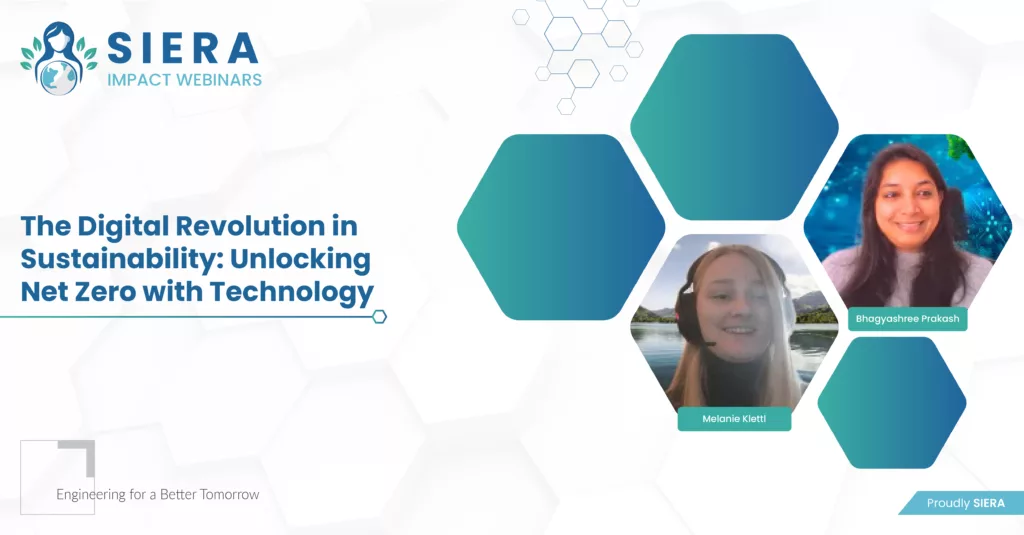
The global push toward sustainability has never been more urgent. With over 140 countries committing to net zero targets and regulatory frameworks such as the EU Taxonomy, CSRD (Corporate Sustainability Reporting Directive), and ESRS (European Sustainability Reporting Standards) taking shape, businesses now face both unprecedented challenges and transformative opportunities. The recent SIERA Academy Impact Webinar brought together experts of the SIERA Alliance to explore how digital tools can unlock pathways to net zero, create resilience, and turn compliance into a competitive advantage.
Why Net Zero Matters
Net zero refers to balancing greenhouse gas emissions produced with the equivalent removed or offset. The Paris Agreement outlines the goal of limiting global warming to 1.5°C, requiring net zero emissions globally by 2050. Achieving this balance is not just about climate stability; it also drives innovation, job creation, and economic growth. Companies, governments, and regions alike are embracing net zero strategies as a cornerstone of future resilience.
The Rise of Digital Sustainability
The global digital sustainability market is valued at $21 billion today, with projections to hit $34 billion by 2027, growing three times faster than the broader tech sector. Europe stands at the forefront, holding 84% of global sustainability fund assets, far outpacing the US. This growth is fueled by regulatory frameworks such as CSRD, SFDR, and EU Taxonomy, which demand transparent, forward-looking disclosures.
The momentum is clear: digital technologies are no longer optional add-ons; they are the backbone of sustainable business transformation.
Challenges on the Path to Net Zero
Despite rapid advances, organizations still face significant hurdles:
- Scalability & High Costs
Advanced solutions like carbon capture, IoT platforms, and AI-driven traceability require heavy upfront investments. Scaling pilot projects across global operations remains complex and capital intensive. - Data Fragmentation
ESG data often exists in silos across departments, suppliers, and legacy systems. This lack of integration hinders real-time decision-making and reliable disclosures. - Regulatory Complexity
With evolving standards across regions, businesses struggle to keep pace. Ensuring transparency and supply-chain-wide accountability is a major challenge without robust digital systems.
Opportunities Through Technology
Where challenges exist, technology provides solutions that redefine sustainability as an opportunity rather than a burden:
- Unlocking Green Capital
Transparent reporting and digital-first compliance attract ESG-focused investments and sustainability-linked financing. Falling costs in renewables and clean tech make projects increasingly bankable. - Data-Driven Pathways
AI, blockchain, and IoT platforms enable real-time monitoring, enhancing accuracy and turning climate ambitions into measurable actions. - Compliance as Competitive Advantage
Instead of being viewed as costly obligations, forward-looking companies leverage compliance to build brand trust, enter new markets, and gain investor confidence.
Key Digital Solutions for Net Zero
- Unified Digital Data Hubs
By centralizing sustainability, finance, and operations data, organizations can gain real-time insights and ensure alignment with net zero targets. This creates a single source of truth, enabling faster decisions and accurate reporting. - Smart Reporting Dashboards
Automating ESG disclosures ensures alignment with evolving EU frameworks. Dashboards not only simplify reporting but also enhance transparency, enabling stakeholders to track progress against goals. - Green Finance & Scalable Models
Blockchain-based platforms open access to climate funds, green bonds, and sustainability-linked loans. Cloud-based pay-as-you-grow models reduce barriers for SMEs and mid-sized businesses. - Sustain Suite – Powered by SIERA
This SaaS platform integrates real-time data collection, gap analysis, CSRD reporting, stakeholder engagement, and transformation insights. Sustain Suite ensures companies remain audit-ready, compliant, and investment-attractive.
Case Insights: Digital Innovation in Practice
Examples across industries illustrate the power of digital sustainability:
- Energy: Smart grids and predictive analytics optimize supply and demand, reducing emissions.
- Manufacturing: Digital twins simulate production processes, cut resource use, and identify inefficiencies.
- Water Infrastructure: IoT-enabled SCADA systems monitor and reduce non-revenue water, improving efficiency and returns for municipalities.
- Fashion: Blockchain-enabled tags provide traceability of materials, ensuring transparency and supporting circular economy initiatives.
These use cases prove that the principles of digital net zero are transferable across industries, from agriculture to logistics.
Ethical Considerations: AI in Sustainability
While AI accelerates decision-making, risks remain. Algorithms trained on biased data may neglect underserved regions. Additionally, black-box AI systems limit transparency. To mitigate risks, organizations must pair AI with human oversight, regular audits, and transparency mechanisms. AI should act as an advisor, not the final decision-maker.
Partnerships as a Growth Catalyst
The acceleration of digital sustainability depends on partnerships:
- Startups bring innovation and cutting-edge tools.
- Corporates provide scale, resources, and implementation.
- Governments set regulatory frameworks and incentives.
Together, these actors can mainstream sustainable technologies faster, bridging the gap between concept and widespread adoption.
Turning Compliance into Action
The CSRD requires businesses to disclose transition plans with forward-looking metrics. ESRS E1 on climate change mandates Scope 1–3 reporting, energy usage, and net zero targets. Meanwhile, SFDR ensures that financial institutions fund genuinely sustainable projects. These frameworks create accountability and eliminate greenwashing by requiring digital, transparent, and verifiable disclosures.
As emphasized in the webinar, digital tools can transform regulatory alignment from a reactive burden into proactive market differentiation.
The Role of the SIERA Alliance
At the heart of these transformations is the SIERA Alliance, uniting experts, technologies, and companies under one mission: Engineering for a Better Tomorrow. Through initiatives like the SIERA Academy Impact Webinars, white papers, and the Sustain Suite platform, SIERA delivers actionable knowledge, innovative tools, and real-world impact.
By combining compliance expertise with cutting-edge technology and a focus on return on investment, SIERA helps organizations implement solutions that are not only environmentally responsible but also financially sustainable.
Call to Action
The pathway to net zero is complex, but the roadmap is clear. Digital technologies offer the visibility, accountability, and scalability needed to turn ambition into measurable action.
🤝 Book a consultation with SIERA experts to tailor strategies for your organization.
🌱 Partner with SIERA Alliance and Sustain Suite to simplify your CSRD reporting and align with EU regulations.
Sustainability starts with informed decisions. Together, we can build resilient, cost-efficient, and low-carbon infrastructure for the future.