

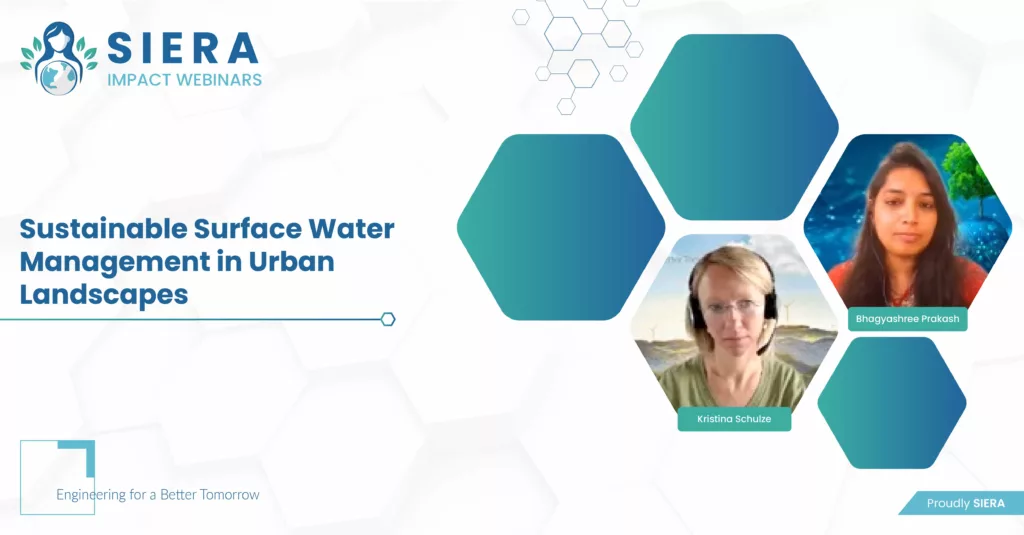
Last week’s SIERA Impact Webinar explored how cities can move from “drain fast” to “live with water”—using blue-green infrastructure, real-time monitoring, and spatial analytics to build climate resilience. Below is a concise reflection for our website audience, aligned to our blog SOPs and optimized for search, with practical takeaways for SIERA member companies and municipal partners.
Why this matters now
Across Europe, heavier cloudbursts, longer dry spells, and aging drainage systems are converging. The result: more frequent surface flooding, combined sewer overflows, and stressed receiving waters. These pressures touch compliance, finance, and reputation—so the operational response needs to be strategic, not just reactive.
The four Challenges Cities Keep Bumping Into
Before listing the headline challenges, it’s worth noting that they’re interlinked. Fixing one in isolation rarely holds; the winning strategies treat the urban water cycle as a system.
- Pluvial flooding pressure
Intense, short-duration rainfall overwhelms pipes and inlets, causing surface water to pond and flow along streets. Traditional conveyance alone can’t keep up. - Riverine flood exposure
Higher River stages and encroachment into floodplains increase exposure of people and assets; early-warning and adaptive protection must work in tandem. - Runoff pollution gaps
Diffuse pollutants—from sediments to micro-pollutants—spike during storms, challenging Water Framework and Urban Wastewater Treatment objectives. - Fragmented hydrological data
Disconnected rainfall, surface, and groundwater records slow evidence-based decisions, planning approvals, and cross-department coordination.
EU Water Policy and Why it Matters for Surface Water
A strong policy backbone turns good engineering into compliant, fundable, and durable programmes. The table below highlights the directives that framed our discussion.
| EU Water Policy / Directive (Keyword) | Surface Water Management Relevance |
| Water Framework Directive (WFD) | Drives “good status” for surface waters; underpins monitoring and source-control for runoff quality. |
| Floods Directive | Requires coordinated risk assessment, hazard mapping, and long-term protection strategies. |
| Urban Wastewater Treatment Directive (recast) | Expands standards around storm overflows and selected micro-pollutants impacting receiving waters. |
| Environmental Quality Standards Directive (EQSD) | Sets concentration limits and consistent monitoring for priority substances. |
| Nature Restoration Law | Pushes restoration of wetlands and floodplains—key for attenuating peaks and improving quality. |
From strategy to Site: What Effective Solutions Look Like
Each city’s recipe will differ, but the following solution areas repeatedly delivered benefits in our session. Success comes from combining engineered conveyance with nature-based drainage and digital oversight—so you can throttle flows, store water locally, and make data-led decisions.
- Integrated stormwater systems
Pair vegetated swales, green roofs, permeable paving, and decentralized detention with dynamic controls to slow, store, infiltrate, and safely release runoff. - Flood-resilient protection
Upgrade embankments and culverts where needed, but link them to real-time hydrology, forecasting, and adaptive design to protect communities as patterns shift. - Smart water-quality networks
Deploy event-based sensors and auto-samplers at key outfalls; stream validated parameters (e.g., turbidity, COD) into dashboards for faster action. - Spatial water analytics
Fuse sensor feeds, GIS, terrain, and modelling into one pane of glass—enabling predictive maintenance, targeted retrofits, and transparent reporting. - A digital backbone for ESG & compliance
Use platforms that connect drainage assets, permits, and performance to CSRD/ESRS and EU Taxonomy, turning monitoring into auditable progress.
Voices From The Session
Our keynote framed water as “a security, infrastructure, and strategic resilience issue”—a shift from narrow drainage toward city-wide risk management. During the Q&A, Kristina Schultze emphasized the power of collaboration, robust calibration, and early modelling to make designs both efficient and future-proof. Together, these messages align with our ethos: Engineering for a Better Tomorrow.
A Simple Metrics Framework You Can Start Using
Clear metrics help SIERA member companies and municipalities prioritize investments and track impact. The lines below introduce a lightweight, defensible set that maps neatly to policy and ESG reporting.
- Peak flow attenuation (L/s reduced)
Quantify throttled discharge at critical nodes to demonstrate local flood-risk reduction. - Runoff volume managed on site (m³/year)
Track infiltrated and detained volumes to evidence sponge-city function. - Receiving-water quality improvement (parameter deltas)
Use event-based sampling to show fewer exceedances against EQSD thresholds. - Green-blue coverage (m² / % of catchment)
Monitor functional area of bioswales, permeable paving, and retention features. - Data completeness & latency (%, minutes)
Report the share of assets with live feeds and average time to insight during storms.
How the SIERA Alliance and Our Partners Can Help
When we refer to companies in this space, we position them within the Alliance to maintain brand clarity and credibility. Our ecosystem combines on-the-ground engineering, digital tooling, and regulatory insight to accelerate impact.
- Expertise
Multidisciplinary planning, modelling, and EU compliance support that turns objectives into buildable, review-ready designs. - Technology
Data integration, real-time monitoring, and transparent performance reporting to manage flood risk and water quality with confidence. - Return on investment
Risk-reduction with measurable ESG gains—often unlocking funding and avoiding costly retrofits later.
If you joined the session and want to take the next step, here are three simple moves to convert ideas into outcomes:
- Book a consultation with SIERA experts to scope your urban drainage, quality monitoring, or compliance roadmap.
Start with a short discovery call and leave with a clear, costed set of options. - Explore SustainSuite to streamline CSRD/ESRS reporting linked to real surface-water performance.
See how asset data, permits, and KPIs flow into dashboards your auditors and stakeholders can trust. - Join the next SIERA Impact Webinar on resilience engineering.
Stay current on policy changes, design tactics, and digital practices from across the Alliance.