

In the field of environmental engineering, the professional handling of mineral waste is becoming increasingly important – especially when asbestos is involved. Regulatory specifications, technical limits and occupational health and safety requirements place high demands on planning, dismantling and disposal.
Against this background, this article deals with the Recycling ban for mineral waste with intentionally added asbestos. The categorisation is carried out from an environmental and legal perspective and is particularly relevant for infrastructure, transport and civil engineering structures. The technical classification takes place, among other things, in the context of the environmental expertise of BIG – Member of the SIERA Alliance.
Technical background: Asbestos in mineral building materials
Differentiation between natural and intentionally added asbestos
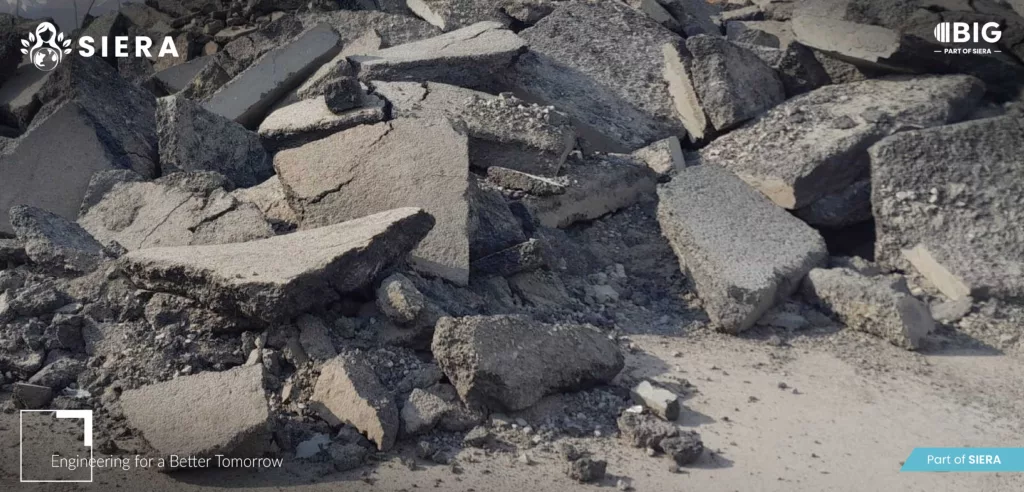
The highly stressed road surface layers in particular often incorporate basic, magmatic rocks such as basalt, diabase or gabbro, which can contain natural proportions of asbestos minerals. In the 1960s and 1970s in particular, asbestos fibres were also intentionally added (e.g. in joint sealants for concrete road surfaces or as asbestos-containing spacers in bridge structures).
Legal framework: Chemicals, hazardous substances and waste legislation
Prohibitions according to ChemVerbotsV and REACH
According to Section 3 (1) of the Chemicals Prohibition Ordinance (ChemVerbotsV) in conjunction with Annex XVII of Regulation (EC) No. 1907/2006 (REACH Regulation), the manufacture, placing on the market and use of asbestos fibres and of articles and mixtures to which these fibres are intentionally added is prohibited. This ban does not apply to naturally occurring mineral raw materials and preparations and articles made from them that contain asbestos with a mass content < 0.1 %.
Delimitation according to the Hazardous Substances Ordinance
According to Section 16 (2) in conjunction with Annex 2 No. 1 (asbestos) of the Hazardous Substances Ordinance, the extraction, processing, further processing and reuse of naturally occurring mineral raw materials and preparations and products made from them that contain asbestos is only prohibited with a mass content of 0.1 % or more.
Classification according to TRGS 517 and waste legislation
Limit values and declaration
According to the specifications of TRGS 517, layers with a proportion of respirable asbestos fibres according to WHO < 0.008 M.-% must be declared „asbestos-free“. „Special measures“ for occupational health and safety are not required. With an asbestos content WHO ≥ 0.008 M.-%, the layers must be declared as „asbestos-containing“, but are classified as „non-hazardous waste“ up to the limit of 0.1 M-%.
According to the Hazardous Substances Ordinance, mixtures and products with an asbestos content of less than 0.1 M.-% may be reused. Irrespective of this, „special measures“ for occupational health and safety are required for the removal of layers containing asbestos.
From a mass content of ≥ 0.1 M.-%, it is waste that may no longer be placed on the market and must be disposed of as hazardous waste.
Measurement results and evaluation
No rounding of analysis values
Please note when specifying the results: Values are not rounded, i.e. a result of e.g. 0.099 M.-% is not rounded up to 0.1 M.-%. This means that the value is below the value of 0.1 M.-% and is therefore categorised as „non-hazardous waste“.
Special feature: Intentionally added asbestos
Exclusion from the circular economy
There are no exemptions from restriction regulations for intentionally added asbestos. As soon as asbestos is detected, it must be removed from the circular economy in accordance with the ChemVerbV in conjunction with the REACH Regulation, regardless of its mass content.
Demolition, separation and mass observation
Unaltered original text:
If it turns out that asbestos products have been used, it must be checked with regard to the KrWG whether these products can be separated from the rest of the building. If this is not the case, a mass analysis is required, i.e. the mass of asbestos must be converted to the mass of the building.
Possible constellations for disposal
➢ If the mass fraction is less than 0.1 M.-%, the demolition waste must be disposed of as non-hazardous waste with the waste code 17 01 01 concrete with the addition „contains asbestos“ at a landfill authorised for this purpose.
With a mass fraction of ≥ 0.1 M.-%, the demolition material must be disposed of as hazardous waste with the waste code 17 06 05* Asbestos-containing building materials at a landfill authorised for this purpose.
It is not permissible to extrapolate the asbestos content to the total demolition material in order to make the declaration „asbestos-free“. If spacers containing asbestos are present, the entire demolition material must be categorised as „containing asbestos“.
Significance for practice in the environmental and engineering sector
For engineering and environmental projects – especially in transport and infrastructure construction – the Correct classification of asbestos content crucial for planning security, occupational safety and legally compliant disposal. Specialist expertise, such as that provided by BIG- Member of the SIERA Alliance The Environmental Technology division supports clients in the legally compliant implementation of complex requirements.
👉 Are you planning demolition, renovation or infrastructure measures with mineral waste?
The experts from BIG- Mimember of the SIERA Alliance support you with sound environmental advice and practical solutions – all in the spirit of Engineering For a Better Tomorrow.