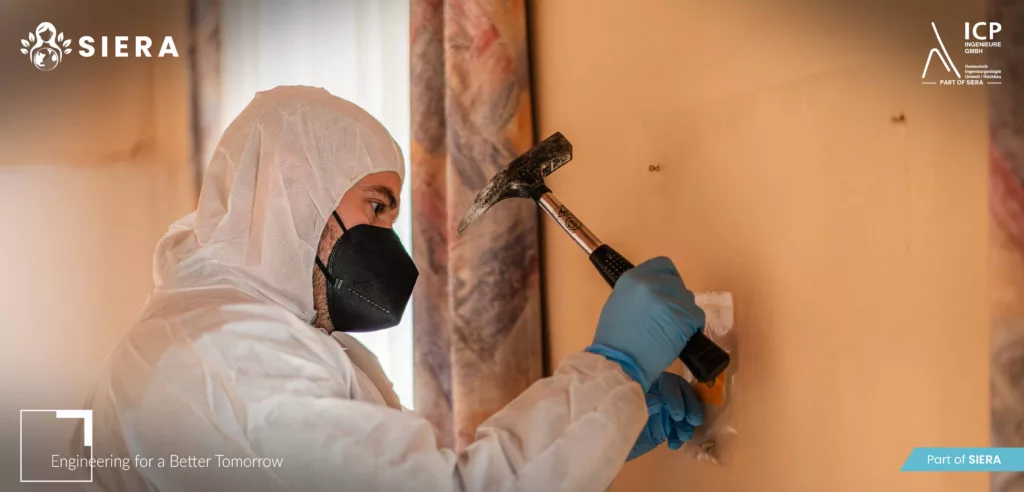



Safety and responsibility before construction work
Interventions in the building fabric – whether through renovation, remodelling, demolition or dismantling – not only entail technical risks, but also health and environmental risks. In existing buildings in particular, it is not always clear which materials containing pollutants have been used. This is precisely where a professionally compiled pollutant register provides clarity and certainty. As an experienced engineering office in the environmental sector, the Prof. Burmeier Ingenieurgesellschaft mbH – Member of the SIERA Alliance clients and owners in the responsible preparation of their building projects.
What is a pollutant register?
A pollutant register (also known as a building pollutant register) is a systematic recording, assessment and documentation of all materials present in a building or on a property that are hazardous to health and the environment. It is used to identify and assess these materials prior to planned construction measures such as renovation, remodelling, demolition or dismantling and to ensure safe handling and proper disposal.
The main purpose of a pollutant register is to provide clarity about potential risks in advance of construction work. Among other things, it serves to ensure the health and safety of workers on the construction site (occupational health and safety), to plan the correct separation and disposal of waste in accordance with the applicable waste regulations and to protect local residents and the environment from the release of pollutants.
Legal requirements and the responsibility of building owners
It should be noted here that, according to the new Hazardous Substances Ordinance (2024), private households must also provide information on existing or suspected hazardous substances to the companies carrying out the work in the event of demolition or conversion work on buildings constructed before 1993.
This regulation makes it clear that the responsible handling of potentially hazardous substances no longer only concerns commercial or public building owners, but that private owners also have a duty.
Contents of a professional pollutant register
Typically, a pollutant register contains information about the history and utilisation of a building. This also includes the construction method and technical installations, and suspicious components are localised and described.
The main components include
- Recording the building history and utilisation
- Analysis of the construction method and technical installations
- Localisation and description of suspicious components
- Taking material samples
- Documentation of sampling in sampling protocols
- Summary of the results of the laboratory analyses in a report
The risk situation is assessed on the basis of the analyses and recommendations are made for the necessary remediation or disposal.
Typical pollutants in existing buildings
Especially in older buildings, often built before 2000, there are materials that are now considered hazardous to health. These typically include
- Asbestos
- Artificial mineral fibres (KMF)
- Polychlorinated biphenyls (PCBs)
- Polycyclic aromatic hydrocarbons (PAHs)
- Wood preservative
- Heavy metals (e.g. in paints or installations)
Early identification of these substances is crucial in order to avoid uncontrolled releases during construction work and to comply with legal requirements.
Professional preparation and legal categorisation
A pollutant register is usually compiled by specialised experts or engineering firms. The creation of a pollutant register is not always explicitly required by law in Germany, but is indirectly required by various regulations in the field of occupational health and safety and environmental protection – such as the Technical Rules for Hazardous Substances (e.g. TRGS 519 for asbestos).
In the case of commercial or public buildings and prior to major construction work, it is essential to fulfil the due diligence obligations as a builder or owner and to avoid liability risks.
Support from BIG
If you are planning remodelling or demolition work, we at Prof. Burmeier Ingenieurgesellschaft mbH – Member of the SIERA Alliance We will be happy to assist you with the creation of a pollutant register. With our specialist expertise in environmental engineering, we can support you from the initial survey and assessment through to well-founded recommendations for remediation and disposal.
Engineering for a Better Tomorrow!
Are you planning interventions in the building fabric or do you need clarity about possible pollutants in your building?
Talk to us – We support you reliably and competently in the creation of your pollutant register.