


Company, location:
Mull und Partner Ingenieurgesellschaft mbH Nord – Member of the SIERA Alliance
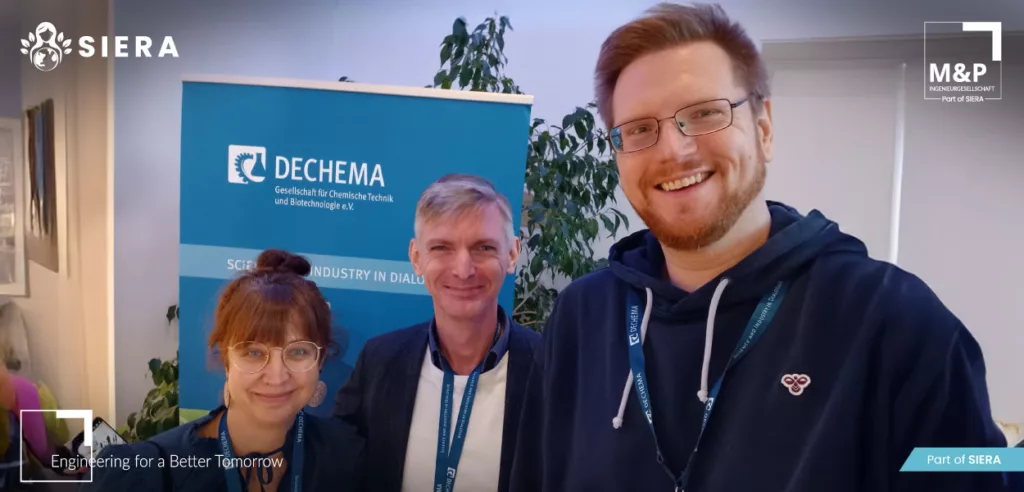
The DECHEMA symposium on the remediation of contaminated sites is one of the central specialist events for soil and groundwater remediation in Germany. Once again this year, Mull und Partner Ingenieurgesellschaft mbH Nord was represented at the 27th DECHEMA Symposium to discuss the latest technical developments, scientific findings and practical solutions.
The DECHEMA Symposium as an established industry meeting place
The DECHEMA Symposium has been bringing together experts from engineering practice, science, authorities and industry for many years. The focus is on proven remediation methods as well as new challenges arising from regulatory, technological and social changes.
For Mull und Partner Ingenieurgesellschaft mbH Nord, participation in such events is an important part of professional development and continuous dialogue within the industry.
Technical review of the 27th DECHEMA Symposium
As a major industry meeting for soil and groundwater remediation specialists in Germany, the DECHEMA Symposium is also a real fixture and highlight in the annual calendar for Mull und Partner Ingenieurgesellschaft mbH. The reason for this is not least the successful mix of carefully curated key topics.
Once again this year, no one was able to avoid the perennial favourite PFAS. This large family of industrial chemicals with its wide range of properties, many of which make it a particular challenge for soil and groundwater remediation, was not just the subject of one presentation session. There was hardly a stand of a well-known industrial exhibitor that did not put its ideas and products on this topic prominently in the spotlight.
On the second day of the event, however, special space was deliberately given to a topic that is otherwise often underestimated: interface work between groundwater remediation and management. The initial hypothesis was that far too often contaminated site remediators and water managers are still working at cross-purposes, due to the fact that both are working on the same material, but rarely at the same time. The highlight here was the panel discussion in the late morning, which was refreshingly emotional.
This year, the topic of machine learning and stochastic extrapolation will also be on the agenda for the remediation of contaminated sites. In his presentation, Dr Stefan Broda from the Federal Society for Geosciences and Natural Resources presented a project for training a pattern recognition algorithm using groundwater data. Ambitious goal among other things: The calculation of a water level hydrograph for a virtual well in any location in Germany. However, the presentation also made it clear that all endeavours in this direction have to contend with well-known problems in the geosciences: Solid measurement data is rare and spatially widely dispersed, and the data structure is often so heterogeneous that compiling machine-readable learning data sets from existing information alone can account for up to 80% of the project effort.
PFAS as a permanent challenge in refurbishment
The intensive dialogue with PFAS once again emphasised that this group of substances will play a central role in the remediation of contaminated sites in the long term. Their chemical properties place special demands on exploration, assessment and remediation concepts and require continuous further development of existing methods.
Interface work between remediation and water management
Particular attention was paid to the question of how remediation measures and water management concepts can be better harmonised. The discussions made it clear that early and integrative cooperation is crucial in order to avoid conflicting objectives and develop sustainable solutions.
Digitalisation and machine learning in the geosciences
The approaches to machine learning and stochastic extrapolation presented showed the potential of digital tools, but also highlighted the existing limitations. In particular, the availability, quality and comparability of measurement data remain key challenges when implementing data-based methods.
Central topics of the 27th DECHEMA Symposium at a glance
| Thematic focus | Relevance for practice |
| PFAS | High complexity of exploration and remediation |
| Interface work | Need for integrated planning approaches |
| Machine learning | Potential with simultaneously high data requirements |
| Data quality | Basis for reliable forecasts |
Classification for the work of M&P North
The topics covered reflect key issues that also play a major role in day-to-day project work. The professional exchange at the DECHEMA symposium provides valuable impulses for critically reflecting on existing approaches and objectively categorising future developments.
Would you like to find out more about the work of the M&P Ingenieurgesellschaft mbH North – Member of the SIERA Alliance., experienced in the field of contaminated site remediation and groundwater protection?
👉 Get in touch with our team in Hanover or visit our website.
Together we develop sustainable solutions – Engineering for a Better Tomorrow.