

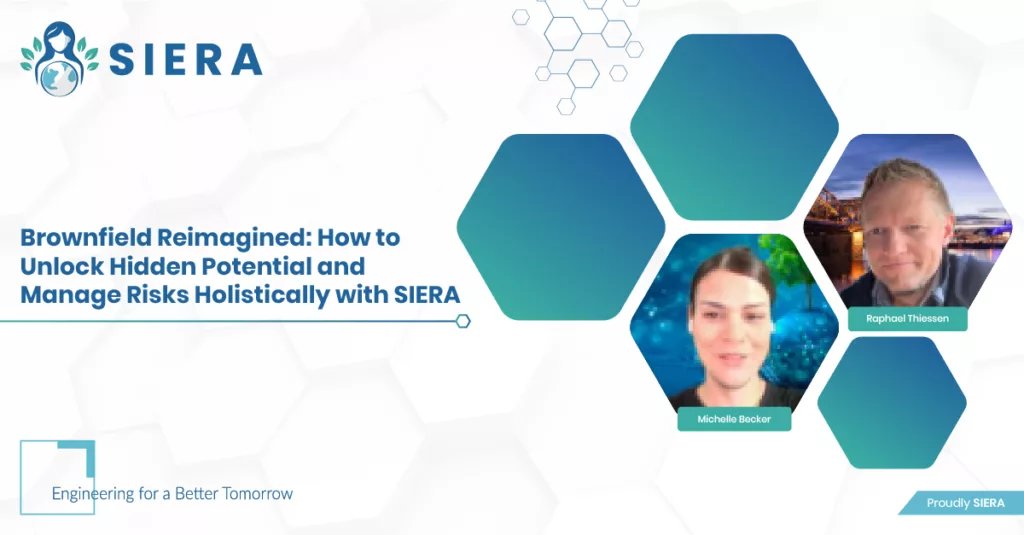
On 21 April, our SIERA Impact webinar focused on a key question in sustainable site development: How can brownfields be strategically activated, assessed, and successfully transformed into new, future-ready uses?
Under the title “Rethinking Brownfields: Unlocking Hidden Potential & Managing Them Holistically with SIERA,” Raphael Thiessen shared valuable insights into the challenges and opportunities of modern brownfield development, and explained why an integrated, interdisciplinary approach is crucial today.
Why Brownfields Are Coming More into Focus
Brownfields are much more than unused or contaminated sites. They are a valuable resource for the future — especially in times of:
- growing pressure on land use
- increasing demands for sustainable urban and district development
- political and regulatory climate targets
- new expectations for ESG-compliant project development
The webinar made one thing clear:
The revitalisation of existing sites is a key lever for sustainable development. Instead of sealing new land, brownfields can help create new spaces for districts, commerce, and nature.
A particularly relevant context is this: large areas of land in Germany are still being used for settlement and transport purposes, while at the same time the goal of climate neutrality by 2050 is increasing the pressure to act. This is exactly why brownfield strategies are becoming significantly more important.
The Key Challenges of Brownfield Projects
A major topic of the webinar was the complexity of such projects. Brownfield development is rarely just a matter of land reuse. Instead, a wide range of requirements must be addressed, including:
- environmental and contaminated site issues
- infrastructure and site development requirements
- water management and climate-related risks
- requirements arising from ESG, EU Taxonomy, and the Green Deal
- economic feasibility and financing options
- municipal, technical, and regulatory coordination
This complexity makes it clear why isolated individual solutions are often not enough. Successful brownfield projects require holistic management across all project phases.
SIERAs End-to-End Approach
A key focus of the webinar was SIERA’s Brownfield 2.0 model. The approach is clear:
From assessment to implementation, SIERA supports the entire process.
In doing so, SIERA brings together different specialist disciplines in an integrated solution approach. The webinar showed how this end-to-end approach helps develop brownfields in a structured and efficient way — with technical, ecological, economic, and regulatory requirements in mind.
The core areas of expertise include:
- Land & Brownfield
Assessment, remediation, and reactivation of complex sites - Urban Planning & Engineering
Integration of environment, mobility, and built infrastructure - Flood and Water Management
Risk modelling and development of suitable protective measures - Climate, ESG & Finance
Strategies, reporting, and financing for credible, future-ready projects - Energy and Asset Management
Development of energy concepts and safeguarding long-term asset performance
This interdisciplinary approach makes SIERA a strong partner for holistic brownfield development.
About SIERA: Where environmental expertise meets engineering precision
The webinar also made clear what particularly distinguishes SIERA in this field: the combination of environmental responsibility and engineering precision.
SIERA combines an integrated environmental engineering network of expertise with broad specialist depth and strong implementation capabilities. This includes:
- 800+ environmental experts
- 36+ specialised companies
- 14 integrated units within one ecosystem
- 20+ years of experience
- 26+ office locations in Germany and across Europe
- 3,500+ environmental and engineering projects per year
With this setup, SIERA can not only assess brownfield projects with strong technical expertise, but also manage them effectively across interfaces, from environmental and remediation topics to infrastructure, climate, and sustainable development.
The Most Important Insight from the Webinar
The webinar’s central message was clear:
Brownfields are not problem sites, they are development opportunities.
However, anyone looking to unlock hidden potential needs a partner who can manage complexity, bring specialist disciplines together, and guide projects strategically from start to finish. That is exactly what SIERA stands for with its integrated end-to-end approach.
Did you miss the webinar?
If you are involved in sustainable site development, land reactivation, ESG-compliant project development, or holistic environmental and infrastructure management, connecting with our experts is well worth it.
Stay connected with SIERA and discover more insights into future-ready environmental and engineering topics.
Save the date: Our upcoming webinars and events
We warmly invite you to join our upcoming formats and engage directly with our experts.
- Gain current insights into relevant specialist topics
- Discover practical solution approaches
- Exchange ideas on challenges and opportunities in your projects
Don’t miss SIERA’s upcoming webinars and events.
Visit our website and stay informed about new dates and content.
For questions about brownfield and site development, you can also contact our speaker directly:
Raphael Thiessen
Brownfield and Site Development
Email: raphael.thiessen@siera.com
The webinar showed: Brownfields are future sites with great potential. What matters is a holistic approach that brings together environment, technology, economic viability, and regulation. This is exactly where SIERA supports with integrated solutions across the entire project process.
Stay tuned: Discover our upcoming webinars and events and learn more about future-ready solutions with SIERA.
Engineering For a Better Tomorrow