

Engineering resilient, renewable infrastructure in the heart of the city
Delivering sustainable energy systems for complex urban environments requires deep technical expertise, long-term thinking, and close collaboration with project stakeholders from the earliest planning stages. M&P Energy – part of SIERA, specializes in the planning and implementation of integrated energy concepts with a strong focus on geothermal and renewable systems for infrastructure, industrial, and urban development projects. As a SIERA Alliance member company, M&P Energy contributes to a multidisciplinary network of environmental and engineering experts working together under the shared mission “Engineering for A Better Tomorrow.”
One exemplary project that demonstrates this approach is the new ÜSTRA Glocksee operations depot in Hanover. The project highlights how geothermal energy can be successfully integrated into dense urban infrastructure to provide reliable, low-carbon heat over the long term—without disrupting ongoing operations.
Project background: Modernizing a central urban depot
The ÜSTRA Glocksee depot is the central light rail operations facility of ÜSTRA Hannoversche Verkehrsbetriebe AG, strategically located close to Hanover’s city center between the rivers Leine and Ihme. The site has been in continuous use for decades, with existing buildings constructed between 1958 and 1980.
As part of a comprehensive modernization program, the client initiated a phased redevelopment of the site, replacing the aging structures with new, future-ready facilities while maintaining daily operations. The project is being implemented in two construction phases and will ultimately comprise three new buildings:
- A workshop building
- An operations and staff building
- A vehicle hall for the light rail fleet
From the outset, the client defined a clear objective: to establish a renewable and resilient heat supply concept capable of meeting the site’s long-term operational demands while significantly reducing environmental impact.
Energy concept: Geothermal energy as the backbone
To meet these ambitious goals, M&P Energy was engaged at a very early project stage to develop and validate a suitable energy concept. The resulting solution is a hybrid system combining geothermal energy with district heating, designed to ensure both sustainability and security of supply.
Within this system, geothermal energy plays a central role, covering the majority of the site’s heat demand through reliable base-load operation. District heating complements the system, providing additional flexibility and redundancy during peak demand periods.
This integrated approach allows the project to balance environmental performance, operational reliability, and economic efficiency, key criteria for critical urban infrastructure.
From feasibility to implementation: A data-driven planning process
Given the scale and complexity of the site, the geothermal system was developed through a structured, multi-stage planning process.
Feasibility study
The project began with a comprehensive feasibility study, assessing geological conditions, expected heat demand, system sizing, and regulatory requirements. This early analysis laid the foundation for informed decision-making and risk mitigation.
Pilot borehole and site investigation
To validate the assumptions made during the feasibility phase, M&P Energy conducted a field investigation using a 150-meter-deep geothermal pilot borehole. This step provided crucial site-specific data on subsurface conditions and thermal properties.
The insights gained from the pilot borehole were instrumental in refining the system design, ensuring that the final concept was both technically sound and optimized for long-term operation.
System simulation and environmental assessment
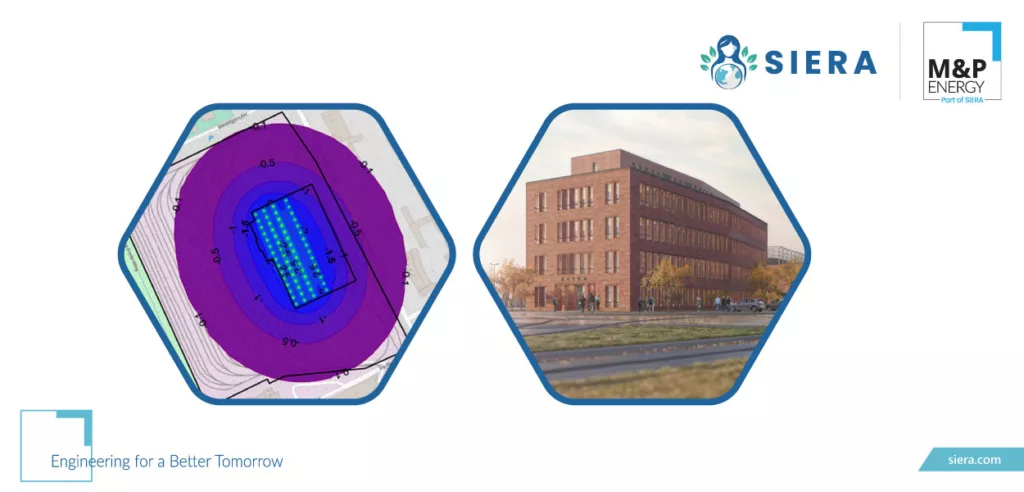
Building on the field data, M&P Energy carried out detailed system simulations, including a 3D simulation of the thermal impacts on the subsurface. These simulations enabled precise assessment of heat extraction and regeneration scenarios over the system’s entire lifecycle.
Based on this robust planning and verification process, the authorities granted approval for the construction and operation of the geothermal system.
Technical system overview
The geothermal installation at the ÜSTRA Glocksee depot is designed to deliver sustainable heat reliably over many decades. Key system features include:
- 60 geothermal probes, arranged in four strings of 15 probes each
- Probe depth: 150 meters
- Boreholes installed beneath the buildings, optimizing land use in the dense urban setting
- Seasonal thermal balance achieved through summer regeneration using photovoltaic-thermal (PVT) collectors
The integration of PVT collectors allows surplus heat generated in summer to be fed back into the ground. This approach effectively turns the subsurface into a seasonal thermal storage system, stabilizing long-term performance and minimizing environmental impacts.
Monitoring, stability, and long-term efficiency
To ensure reliable operation and transparency throughout the system’s lifecycle, the geothermal installation is equipped with a comprehensive monitoring concept:
- A central temperature monitoring point within the probe field
- Temperature and heat meters integrated into the fluid circuit
This monitoring infrastructure supports continuous performance evaluation, early detection of deviations, and long-term operational optimization.
The system follows a clear seasonal operating cycle:
- Winter: Heat extraction from the ground to supply buildings
- Summer: Reinjection of excess thermal energy via PVT regeneration
This balance ensures high operational stability, efficiency, and low operating costs, making the geothermal system a robust infrastructure investment for decades to come.
Geothermal energy for urban infrastructure
The ÜSTRA Glocksee depot project demonstrates how geothermal energy can be successfully deployed even in space-constrained, operationally sensitive urban environments. By combining early-stage involvement, data-driven planning, and integrated renewable technologies, M&P Energy has delivered a solution that aligns environmental responsibility with operational reality.
As cities and infrastructure operators face increasing pressure to decarbonize, projects like this illustrate the vital role that geothermal systems can play in providing long-term, climate-resilient heat supply.
Are you planning an infrastructure, industrial, or urban development project and looking for a future-proof renewable energy solution?
M&P Energy – part of SIERA supports clients from initial feasibility studies through detailed planning, permitting, and implementation of integrated geothermal and renewable energy systems.
Get in touch with our experts to explore how geothermal energy can be tailored to your project’s specific technical, regulatory, and sustainability requirements—and take the next step toward resilient, low-carbon infrastructure.