



As cities across Europe accelerate their transition toward climate-neutral development, integrated energy concepts are becoming a decisive factor in sustainable urban planning. M&P Energy – part of SIERA, specializes in exactly this intersection of engineering excellence, energy efficiency, and forward-looking infrastructure solutions. As a member of the SIERA Alliance, M&P Energy benefits from international knowledge exchange and best practices in environmental engineering, enabling the company to deliver resilient, future-proof energy systems for complex urban developments.
One such project is the Rhenania Quarter in Frechen, where M&P Energy has been commissioned to develop a comprehensive and sustainable energy supply concept. The project exemplifies how renewable energy systems can be embedded into urban structures from the earliest planning stages assuring long-term efficiency, reliability, and climate impact reduction.
An Urban District with Integrated Uses and High Energy Demands
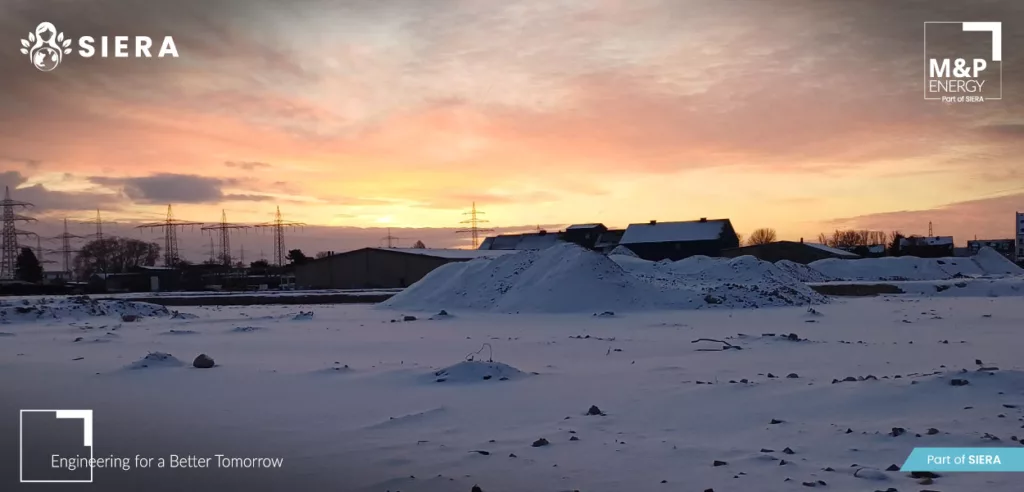
With the Rhenania Quarter, a new urban environment is emerging in Frechen that intelligently interlinks living, working, education, and leisure. On a former industrial site, a diverse district is being developed, comprising residential buildings, office and commercial spaces, as well as social and cultural facilities.
The close interconnection of these uses places high demands on urban planning—and particularly on the overall energy concept. Mixed-use districts require flexible systems that can efficiently respond to varying heating and cooling loads throughout the year. This is where M&P Energy’s expertise in integrated energy systems and district-scale planning becomes a key success factor.
Geothermal Energy as a Central Pillar of the Supply Concept
M&P Energy is currently developing a future-oriented geothermal energy concept, with planning now in the design phase. At the heart of the system is a large-scale geothermal borehole field, designed to supply the district with renewable heating and cooling over the long term.
The use of shallow geothermal energy represents a central building block in achieving a climate-friendly and resource-efficient district energy supply. Drawing on its extensive experience in geothermal planning, M&P Energy ensures that the system is optimally aligned with the site’s geological conditions, building structures, and operational requirements.
Comprehensive Site Investigations to Minimize Risk
To safeguard the planning process, M&P Energy is conducting extensive preliminary investigations—an essential step in ensuring technical reliability and long-term operational stability.
In January, unexploded ordnance surveys on the remediated site were successfully completed, creating the necessary conditions to proceed with geological investigations without restrictions. At the end of January, three test drillings are scheduled to examine the geological structure in detail and determine the site-specific thermal conductivity of the subsurface.
Building on these results, Geothermal Response Tests (GRT) will be carried out and evaluated in February. The empirical data gained will flow directly into the further development of the energy supply concept. This data-driven approach enables M&P Energy to precisely dimension the geothermal borehole field while simultaneously minimizing planning and operational risks—one of the company’s core competencies in complex infrastructure projects.
High Efficiency Through Intelligent Heating and Cooling Cycles
The system is designed to deliver a heating capacity of approximately 1,000 kW. At the same time, the geothermal borehole field will be almost fully regenerated using surplus heat generated within the district during summer operations.
With an expected renewable share of up to 91%, the concept enables a highly efficient interaction between heating and cooling modes. This balanced energy cycle significantly improves system performance and underscores the holistic, systems-engineering approach that M&P Energy applies to district-scale energy solutions.
Optimized Layout for Urban Integration
Based on current assumptions, the geothermal system will consist of up to 400 boreholes, predominantly located beneath the buildings on the northern side of Rhenania West. This area is expected to experience increased cooling demand, particularly due to the planned office and commercial uses.
The spatial proximity between energy generation and consumption allows for short distribution routes, reduced energy losses, and improved system efficiency—key objectives in M&P Energy’s planning philosophy for sustainable urban energy infrastructure.
A Model for Future-Ready Urban Development
By progressively refining the planning based on ongoing investigation results, M&P Energy – part of SIERA is making a substantial contribution to the development of the Rhenania Quarter as a modern, sustainable, and future-ready urban district.
The project demonstrates how renewable energy technologies—when integrated early and strategically—can form the backbone of resilient urban environments. Supported by the interdisciplinary expertise and international network of the SIERA Alliance, M&P Energy continues to translate complex sustainability goals into technically sound and economically viable solutions.
Are you planning a district, campus, or mixed-use development and looking for a sustainable, future-proof energy concept?
Contact M&P Energy – part of SIERA to explore how integrated geothermal and renewable energy systems can be tailored to your project’s specific needs.
Learn more about SIERA and how collaborative engineering is shaping climate-resilient cities worldwide.
Engineering For A Better Tomorrow.