



Historical aerial photographs form a central basis for the pre-investigation of explosive ordnance, as used today by M&P Ingenieurgesellschaft Nord – Member of the SIERA Alliance is carried out. When researching the events of the Second World War and the aerial photographs taken during this period, one occasionally comes across references to the people behind these images – the pilots who took them under life-threatening conditions. Two of these pilots and their missions exemplify the high historical and technical value of this material.
Historical aerial photographs as the basis for explosive ordnance detection
An important basis for the explosive ordnance pre-investigations carried out by M&P Ingenieurgesellschaft Nord is the historical aerial footage from the Second World War. These images make it possible to recognise potential effects of the war and draw conclusions about possible explosive ordnance contamination.
Analysing historical aerial photographs combines engineering analysis with historical research. It is an essential component of planning security for construction and infrastructure projects and contributes significantly to the identification of areas suspected of containing explosive ordnance.
Robert R. Smith – Aerial photographs over Düren and Bonn
On 26 November 1943 manufactured Robert R. Smith during a reconnaissance flight in space Düren/Bonn an aerial photograph that shows more than 80 years later was used by M&P Ingenieure Nord in the course of an aerial photo evaluation for the pre-investigation of explosive ordnance in order to detect potential war effects.
Military background
Smith joined the company in summer 1943 to the US-American 7th Photographic Reconnaissance Group, at the English airfield at that time. Mount Farm, about 100 kilometres north-east of London, was stationed there. Already on 27 June 1943 he completed his first reconnaissance flight for this unit.
Information on the aircraft used and the units of this period can be found today in the American Air Museum Archive documented
(https://assets.americanairmuseum.com/).
Shot down and prisoner of war
During a reconnaissance flight over Cottbus Robert R. Smith was born on 14 August 1944 shot down by German anti-aircraft fire. He managed to land his plane and bail out of the burning aircraft. He was then taken prisoner of war, where he remained until the end of the war.
However, the aerial photographs taken by Smith are still valid today and continue to be used for expert assessments in the field of explosive ordnance detection.
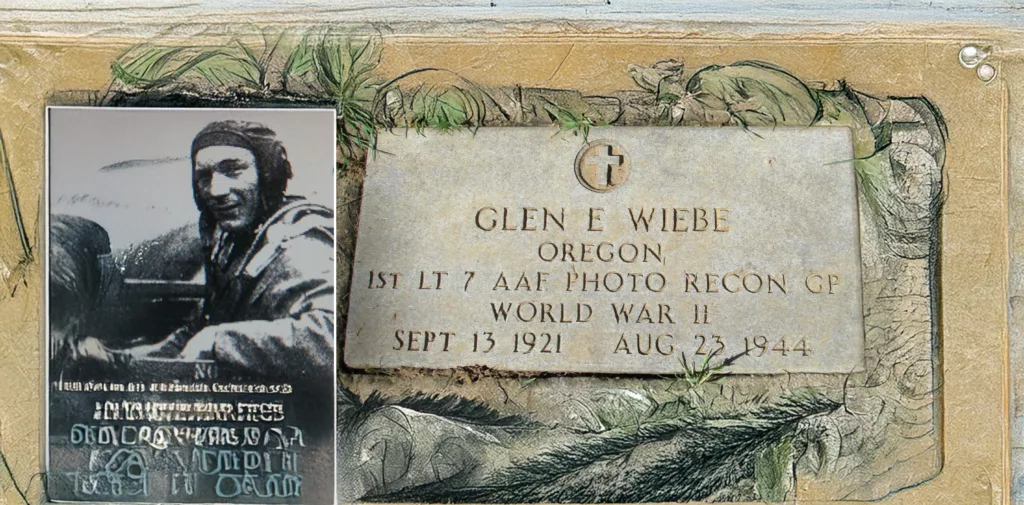
Glen E. Wiebe – Aerial photographs from the Wolfsburg area
Another example is Glen E. Wiebe, which was published on 2 August 1944 Aerial photography in space Wolfsburg was made. These historical aerial photographs were also used by M&P Ingenieurgesellschaft Nord as part of an aerial photo analysis for the pre-investigation of explosive ordnance.
Deployment with the 7th Photographic Reconnaissance Group
Wiebe arrived on 22 May 1944 also to the 7th Photographic Reconnaissance Group and was – like Robert R. Smith – at the airfield Mount Farm stationed at the airport. Within a short time, it carried out several missions over German territory.
Death in action
Only a few weeks after the above-mentioned assignment, Glen E. Wiebe was 23 August 1944 with Fribourg was shot down by German fighter planes and lost his life. He was only 23 years old. Information about his grave and his military career is still documented today
(https://de.findagrave.com/memorial).
Nevertheless, his aerial photographs represent a lasting contribution to the assessment of areas suspected of containing explosive ordnance.
Significance for today’s engineering practice
The example of these two pilots clearly shows the conditions under which life-threatening conditions the aerial photographs were taken, which today Central basis for the designation and clearance of areas suspected of containing explosive ordnance form.
The work of M&P Ingenieurgesellschaft Nord builds on this historical foundation and combines it with modern engineering methodology. Historical documentation, precise analyses and responsible planning are intertwined.
Overview: Historical aerial photographs and current utilisation
| Pilot | Recording date | Region | Current utilisation |
| Robert R. Smith | 26.11.1943 | Düren / Bonn | Pre-exploration of explosive ordnance |
| Glen E. Wiebe | 02.08.1944 | Wolfsburg | Pre-exploration of explosive ordnance |
Conclusion
Historical aerial photographs are far more than just contemporary documents. They are an indispensable tool for the safe planning of construction and infrastructure measures. The missions of pilots such as Robert R. Smith and Glen E. Wiebe still form a fundamental basis for the specialist work of M&P Ingenieurgesellschaft Nord and impressively demonstrate how closely history and modern engineering are linked.
Find out more about the services of M&P Engineering Company North – Member of the SIERA Alliance in the field of explosive ordnance detection and historical aerial image analysis on our website. Together we stand for Engineering For A Better Tomorrow.