

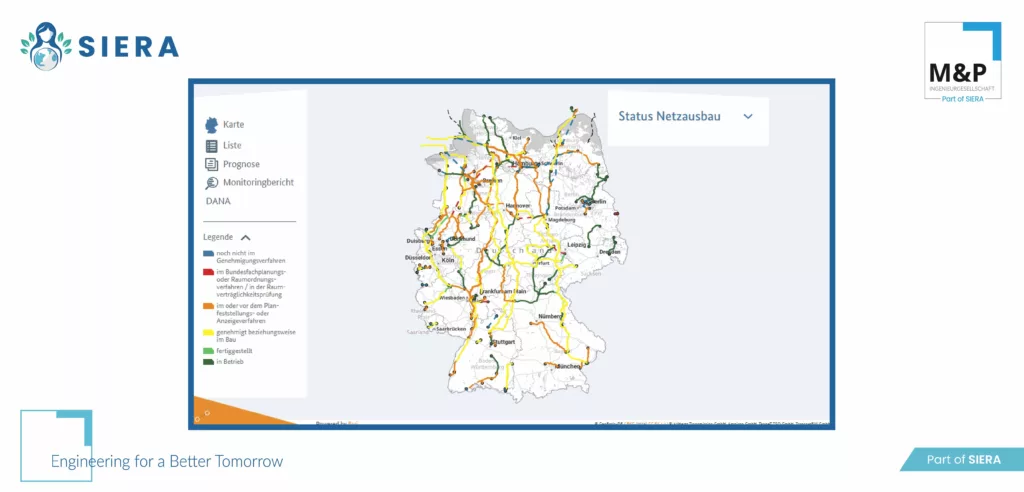
The expansion of the German extra-high-voltage grid is a crucial building block of the energy transition—and it is taking place now. Nationwide, planning, permits and construction work are running in parallel. A significant part of the new lines is already in operation, and further sections are under construction or are about to be approved. In total, several thousand kilometres of new pipeline systems are being built to transport electricity from renewable energies safely, stably and with little loss in the future.
In this complex environment, M&P Ingenieurgesellschaft – a member of the SIERA Alliance – accompanies the responsible steps of grid expansion with comprehensive, professionally qualified environmental assessment and water-related construction supervision.
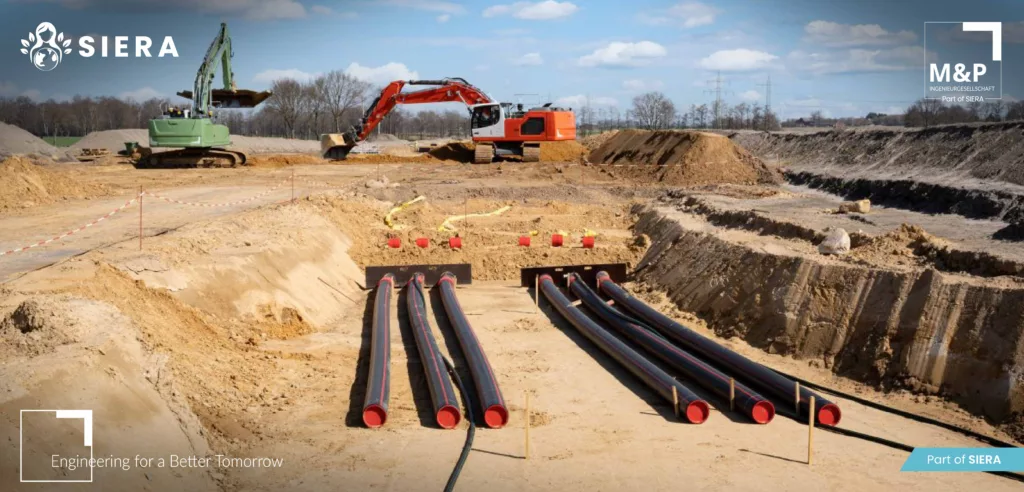
1. What has happened so far in grid expansion
In recent years, a significant part of the network expansion has already been implemented:
- Construction of several hundred kilometres of new extra-high-voltage lines
- Reinforcement of existing routes
- Planning and starting construction of high-performance HVDC lines (direct current connections)
- First sections of major pipeline projects have been approved
- Several major projects are already under construction
The transmission system operators and the Federal Network Agency are driving this development forward in order to make Germany’s energy infrastructure fit for the future.
2. Current status and outlook for the coming years
Germany is in the middle of the implementation phase:
- Numerous approval procedures are running in parallel
- Part of the pipelines has already been completed
- Further projects are under construction
- Many projects are about to be approved
By the early/mid-2030s, central north-south connections are to be completed – including:
- SuedLink
- SuedOstLink
- A-North
In addition, existing power lines are being modernised, new substations are being built and the digitalisation of the grids is being intensively promoted. The aim is stable, flexible and safe electricity transport, even with strongly fluctuating wind and solar power.
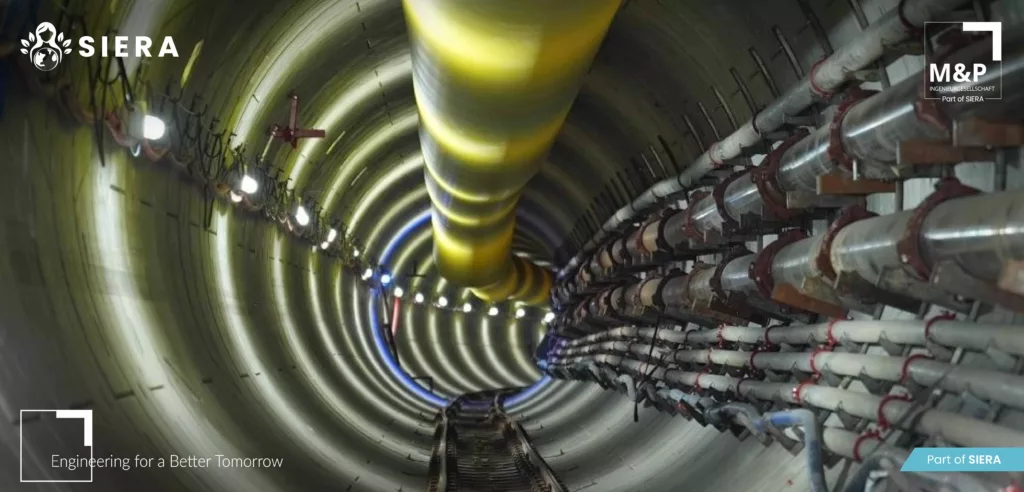
3. Why is the extra-high-voltage grid being expanded?
Grid expansion is crucial to achieve central goals of the energy transition:
Central drivers
| Reason | Significance for grid expansion |
| Energy transition | Renewable energy is often generated far away from the consumption centers – the grid must transport it reliably. |
| Supply | A strong grid prevents bottlenecks and power outages. |
| Shutdown of fossil and nuclear power plants | The loss of power plant capacities requires new transport routes from north to south. |
| Climate protection | Only an expanded grid enables the full use of renewable energies. |
In short: The network expansion is well advanced, but far from complete. It is central to ensuring that Germany will be supplied with reliable, stable and climate-friendly electricity in the future.
4. Contribution of the M&P Ingenieurgesellschaft Hamburg and Hanover – Member of the SIERA Alliance
The extra-high-voltage grid expansion projects are accompanied by experienced specialists. M&P Ingenieurgesellschaft – a member of the SIERA Alliance – plays important roles in the planning and construction phase.
4.1 Environmental assessment on behalf of the Federal Network Agency
Even in the early project phases, M&P Ingenieurgesellschaft ensures that all necessary documents are complete and technically viable. This includes in particular:
- Examination of environmental expert reports
- Assessment of species protection documents
- Checking the technical and legal resilience
- Ensuring completeness and plausibility
The results of these tests are incorporated directly into the approval texts. This ensures that large-scale projects are prepared to a high standard not only technically but also ecologically.
4.2 Hydrological construction supervision – environmental responsibility on the construction site
Even during the construction phase, M&P Ingenieurgesellschaft – a member of the SIERA Alliance – remains actively involved in the project.
As hydrological construction supervision, she will be responsible for:
- Monitoring of all water-related aspects on site
- Protection of soil and groundwater
- Checking whether structural measures comply with environmental goals
- Technical support for water management issues
- Early detection and minimization of potential environmental impacts
This ensures that the expansion of the extra-high-voltage grid is not only fast and reliable, but also environmentally friendly and sustainable.
5. Conclusion: Network expansion can only succeed with technical and ecological quality
The German extra-high-voltage grid expansion is one of the most important infrastructure projects of the energy transition. M&P Ingenieurgesellschaft Hamburg und Hannover – a member of the SIERA Alliance – makes a decisive contribution to this by:
- examines environmental reports
- Approval procedure professionally supported
- water-related construction supervision takes over
- Ensures ecological quality standards
This creates an electricity grid that meets the needs of a climate-friendly, secure and efficient energy future.